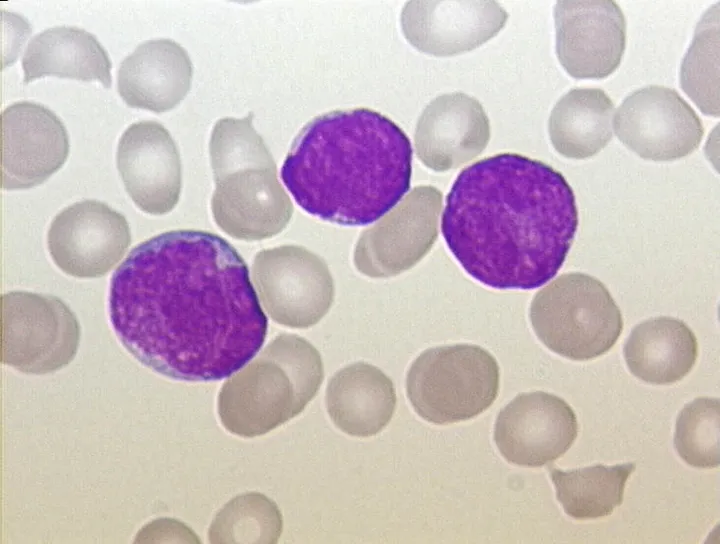
A 4-year-old girl presents for 3 weeks of fatigue, pallor, and refusal to walk because of leg pain. Bone marrow aspirate shows 85% blasts. Flow cytometry shows blasts that are positive for TdT, CD10, and CD19 and negative for myeloperoxidase. Which of the following chromosomal abnormalities is most likely to be found in this patient's blasts?
ATranslocation of chromosomes 15 and 17
BTranslocation of chromosomes 12 and 21
CTranslocation of chromosomes 8 and 14
The immunophenotype is most consistent with childhood precursor B-cell lymphoblastic leukemia, which is most commonly associated with a translocation of chromosomes 12 and 21. A translocation of chromosomes 15 and 17 causes acute promyelocytic leukemia, whose blasts are positive for myeloperoxidase.
Try a question
Real questions from our bank of 6,800+.
A 4-year-old girl is brought to the physician because of 3 weeks of fatigue, pallor, and refusal to walk because of leg pain. She had an upper respiratory tract infection 1 month ago, and her older brother has asthma. Temperature is 38.1°C (100.6°F), pulse is 128/min, respirations are 24/min, and blood pressure is 96/58 mm Hg. Examination shows pallor, scattered petechiae on the lower extremities, and a liver edge palpable 2 cm below the right costal margin. There is no lymphadenopathy or splenomegaly. Laboratory studies show:
Hemoglobin: 7.4 g/dL
Leukocyte count: 24,000/mm3 (68% blasts)
Platelet count: 36,000/mm3
Fibrinogen: 310 mg/dL
Prothrombin time: 12 sec
Lactate dehydrogenase: 820 U/L
Uric acid: 6.8 mg/dL
Bone marrow aspirate shows 85% blasts. Flow cytometry shows that the blasts express terminal deoxynucleotidyl transferase, CD10, and CD19, and do not express myeloperoxidase or surface immunoglobulin. Which of the following chromosomal abnormalities is most likely to be found in this patient's blasts?
How it works
Exam-style questions
Full clinical vignettes with an explanation for every answer choice.
Spaced repetition
What you miss comes back as a question or flashcard just before you'd forget it.
A daily habit
Streaks and a monthly leaderboard keep you coming back. A short day still counts.
Fits your schedule
Study alongside your courses, or switch to exam prep for your dedicated weeks. We've mapped coursework for 8 medical school curricula.
Pricing
$9.99 a month
or $99.99 a year. Founding members keep this price while subscribed.
Zac Kahler, MD, is an academic emergency physician who has taught medical students and residents for more than 15 years. He built Study Bean to help you learn the most in the time you have.
Common questions
Who is Study Bean for?
Medical students preparing for USMLE Step 1. We plan to add Step 2 CK, shelf exams and in-training exams.
How does the free trial work?
Start a 7-day free trial with a card. Cancel before the trial ends and you won't be charged.
Is Study Bean meant for long-term studying, or just for dedicated exam prep?
Both. During your courses, you only get questions on blocks you've covered. When dedicated starts, switch to exam prep and every subject opens up, highest-yield questions first.
Do you have practice exams?
Yes. Study Bean has 13 full-length, USMLE-style practice blocks.
Do you have an app?
Our iPhone app is in development. For now, Study Bean works in any web browser on your computer, tablet or phone.
Who writes your questions?
We start from the official USMLE Content Outline, broken down into a detailed list of topics. Each question is drafted with AI, then fact-checked and reviewed against the NBME's item-writing guidelines in several independent passes. A physician reviews questions on an ongoing basis.